


Key Points
- HB24-1152 took full effect June 30, 2025, mandating ADU allowance in all Colorado subject jurisdictions.
- HOAs in subject jurisdictions cannot ban ADUs—only enforce reasonable aesthetic standards like matching siding or roof pitch.
- Administrative approval is mandatory—no public hearings, no neighbor vetoes if you meet setback and height requirements.
- Subject jurisdictions cover the entire Front Range: Denver, Boulder, Fort Collins, Colorado Springs, Pueblo, and Grand Junction.
- The law also establishes grant funding (ADUG) to help local governments create pre-approved ADU plans.
Here's what happened in Aurora, Colorado, in early 2024. A homeowner wanted to build an accessory dwelling unit (ADU) on her property to house her aging in-laws. She designed a modest 800-square-foot modular unit, submitted plans to her HOA, and waited for approval. The response came back fast: denied. The HOA cited "community character." No further explanation. No negotiation. Just no.
Six months later, in January 2026, she resubmitted those same plans. This time, the HOA could not say no.
Colorado House Bill 24-1152 changed the rules. And not in some incremental way — this is the most transformative housing legislation Colorado has passed in recent memory.
For years, homeowners in Colorado faced a wall of obstruction. HOAs banned ADUs outright. Planning departments required public hearings where neighbors could veto your project. Local officials exercised broad discretion to deny applications based on vague concerns about character or compatibility. Thousands of properties sat locked out of the housing market — underutilized, single-family zones in booming metros like Denver, Boulder, and Colorado Springs.
The state legislature decided that approach was not working anymore. Colorado's housing crisis demanded action. So HB24-1152 essentially overrode local obstruction. It stripped away HOA bans. It eliminated discretionary hearings. It forced municipalities to streamline approval. And it opened up an entirely new category of properties for ADU development.
If you own property in a Colorado metro area, this law affects you. Here's what you need to know.
What Is a "Subject Jurisdiction"?
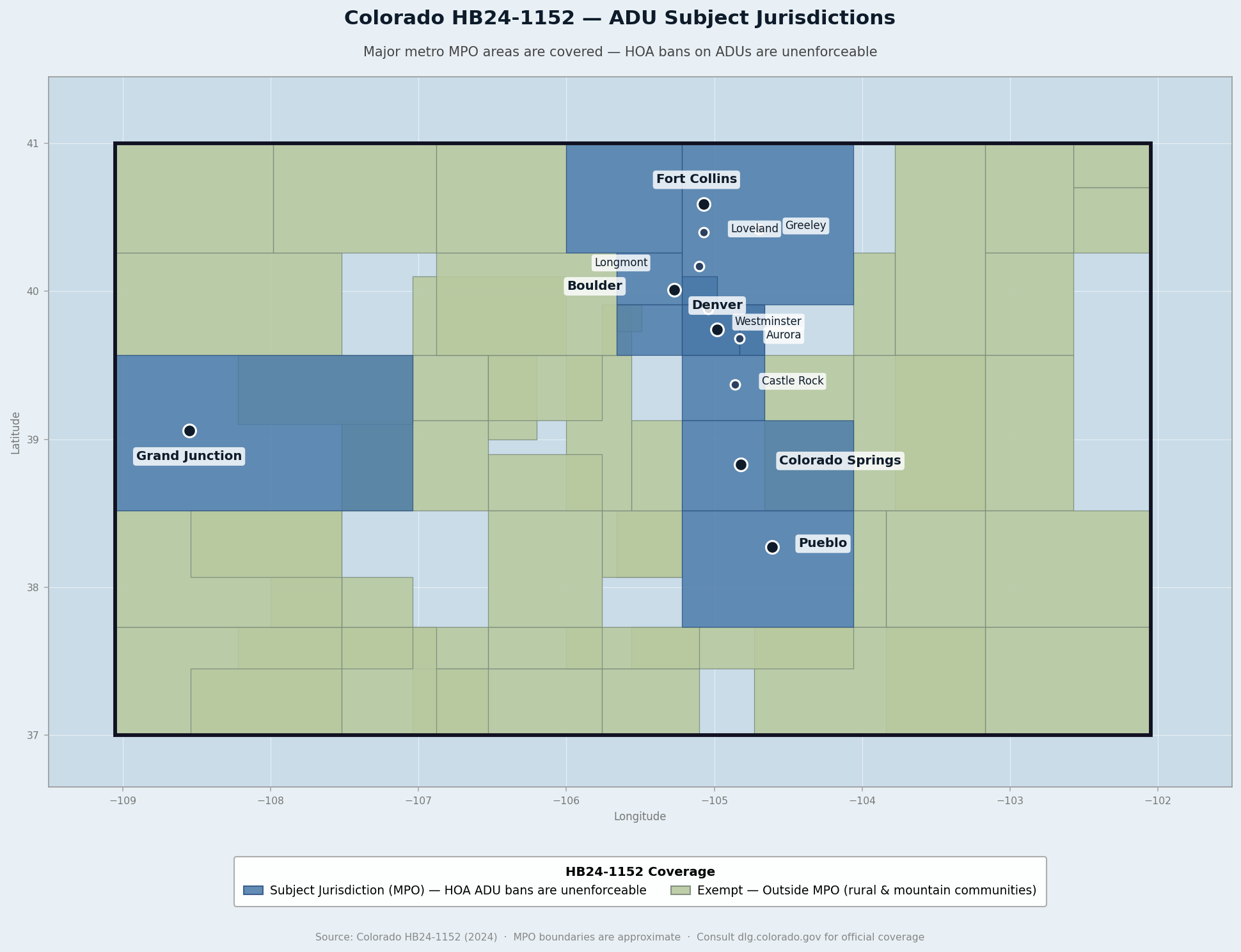
Before we go further, you need to understand one term. It is the key to the whole law: Subject Jurisdiction.
A Subject Jurisdiction is any municipality with a population of 1,000 or more that sits within a federally designated Metropolitan Planning Organization (MPO), plus certain census-designated places in counties with 40,000+ residents within an MPO. That is the legal definition. In plain English, it means the law applies to every major metro area in Colorado.
Let us map this out. The Denver-Boulder-Fort Collins MPO covers the entire Front Range. That includes Denver, Aurora, Boulder, Fort Collins, Loveland, Longmont, Westminster, Broomfield, and dozens of smaller cities and unincorporated areas. The Pueblo metro is a Subject Jurisdiction. The Colorado Springs metro is a Subject Jurisdiction. So is Grand Junction. Weld County (which includes Greeley) qualifies. Larimer County (Fort Collins) qualifies. El Paso County (Colorado Springs) qualifies.
If you live in one of these areas, HB24-1152 applies to your property.
This matters because an MPO is a federal transportation planning entity. Your city or county is part of a larger regional framework. And the state legislature decided that these metropolitan areas have enough housing pressure that they all need to allow ADUs. Communities that fall outside an MPO — small rural towns, mountain counties — are exempt from the law. But if you live in or near any Colorado city you have actually heard of, you are in a Subject Jurisdiction. And your HOA, your city council, and your planning commission all have to comply with HB24-1152.
The End of HOA Bans — What Your HOA Can and Cannot Do
The HOA provision is the jaw-dropper. And it is where homeowners in places like Aurora, Cherry Creek, Highlands Ranch, and Boulder finally catch a break.
Before HB24-1152, HOAs in Subject Jurisdictions could blanket-ban ADUs. "No accessory dwelling units permitted." Period. End of story. That single phrase locked thousands of properties out of development. If you owned a home on a two-acre lot with plenty of space for an ADU, but your HOA said no, you were stuck.
Not anymore. HB24-1152 says HOAs in Subject Jurisdictions cannot prohibit ADU construction as an accessory use to a single-family detached dwelling. Full stop. If you own a single-family home in a Subject Jurisdiction, your HOA has lost the power to say no to an ADU.
But here is what matters: HOAs can still enforce what the law calls reasonable design standards. And if your HOA has bylaws, you need to understand what that means.
Your HOA can still require:
– Matching siding color and material (to the extent reasonably feasible with your design) – Roof pitch matching the primary residence – Setback requirements consistent with neighborhood standards – Height limits (typically matching the main house or not exceeding 35 feet) – Lot coverage limits – Minimum property size thresholds
These are design review standards. They are standard practice in well-run HOAs. The law allows them.
But your HOA absolutely cannot do these things:
– Prohibit ADU construction outright – Require neighbor approval or petition signatures – Impose design standards so strict they make the project financially unviable – Charge special ADU construction fees or increased HOA dues tied to the ADU – Require public hearings or approval by the HOA board (the standards must be objective, not discretionary) – Demand that the ADU remain rented to a family member (some HOAs used this as a de facto ban) – Use community character as a catch-all justification to deny reasonable design plans
The legal standard is buried in the bill's language: restrictions must be "reasonable." That word will get litigated in Colorado courts for years. But the legislature's intent is crystal clear. HOAs can't use design standards as a backdoor way to ban ADUs.
Look, here is the thing. If you live in a Subject Jurisdiction and your HOA denies a reasonable ADU application after July 2025, you likely have grounds to challenge that decision. The law is on your side. Colorado's Division of Local Government has published guidance. You can appeal, and you can force the HOA to justify the denial with specific, objective criteria.
This opens up thousands of suburban properties that were previously locked out of the ADU market. And for homeowners who want to add rental income, create multigenerational housing, or maximize their property's potential, it changes everything.
The Administrative Approval Process — No More Neighbor Vetoes
Even if your HOA permits an ADU, the city or county still needs to approve your plans. And this is where HB24-1152 delivers another massive change.
Historically, ADU applications in Colorado went through the same gauntlet as any development project. You submitted plans to the planning department. They scheduled a public hearing. Your neighbors showed up to oppose the project. Planning commissioners deliberated. Then they either approved or denied your application — often based on vague criteria like consistency with community character or compatibility with neighborhood aesthetics. The whole process took six to eighteen months. Even if you met every technical requirement, a planner could reject your project based on subjective judgment.
HB24-1152 eliminates this. ADU applications in Subject Jurisdictions must follow an administrative approval process. No public hearings. No discretionary review. No neighbor testimony. No planning commission deliberation about aesthetics.
Instead, the planning staff follows a checklist. Does your ADU meet the objective standards? Setback requirements? Height limits? Lot coverage? Utility connections? Parking (if required)? If you check every box, your permit gets issued. If you do not meet a standard, the denial tells you exactly why — and you can revise your plans and resubmit.
In planning terminology, this is called ministerial approval. The official has zero discretion. They are not making a judgment call. They are checking boxes against objective criteria.
This might sound technical. But the practical impact is enormous. Your neighbors cannot veto your ADU. A planner who dislikes prefabricated homes cannot reject your modular unit because they prefer site-built construction. Your application does not get held up because the planning commission wants to study the impacts. If you meet the rules, you get the permit. And the timeline compresses from eighteen months to six weeks.
Honestly, this provision alone justifies building an ADU in Colorado today. The certainty is worth more than money.
Grant Funding and Pre-Approved Plans (The ADUG Program)
The law also includes a funding mechanism. Colorado allocated resources for the ADU Grant (ADUG) program, which helps municipalities create what's called "pre-approved plan sets."
Here is how it works. A city like Boulder or Colorado Springs applies for ADUG funding. They use it to develop three to five standardized ADU designs — say, a 700-square-foot modular unit with a pitched roof, a 900-square-foot design with a flat roof, and a 600-square-foot cottage design. These designs already comply with setbacks, height limits, parking requirements, utility standards, everything.
Then you, the homeowner, can simply select one of these designs, submit your plans, and pull a permit. No custom engineering. No back-and-forth with the planning department. You are not subject to the full design review. You just copy the pre-approved plan, adapt it to your lot (setbacks, site orientation), and you are done. Permitting timeline: two to three weeks.
Some municipalities are using ADUG funding to subsidize ADU construction for low-to-moderate income homeowners. They cover design costs, or they offer grants to offset construction expenses. The program is still rolling out — not every Colorado municipality has launched pre-approved plans yet — but the ones that have are seeing explosive growth in ADU applications.
Before you submit an ADU application in your municipality, check the local government website. Search for pre-approved ADU plans. If your city or county has them, you can skip months of design iteration and permitting hassle.
What This Means for You Right Now
HB24-1152 takes full effect June 30, 2025, for most provisions. But the HOA ban provision? That is already in place. And if you live in a Subject Jurisdiction, the law applies to your property right now.
So what should you do?
First, check whether you are in a Subject Jurisdiction. Visit the Colorado Division of Local Government website at https://dlg.colorado.gov/accessory-dwelling-units. They have published maps and lists. If you live in Denver, Boulder, Colorado Springs, Fort Collins, Pueblo, Grand Junction, or any suburb of these metros, you almost certainly are.
Second, review your HOA documents. Pull your CC&Rs (Covenants, Conditions, and Restrictions). Look for any language prohibiting ADUs. If there is an outright ban, know that it is unenforceable in a Subject Jurisdiction. And if your HOA tries to enforce it, you have legal grounds to challenge the decision.
Third, contact your city or county planning department. Ask three questions: Do we have pre-approved ADU plans? What are the objective standards for ADU setbacks, height, and lot coverage? And who do I talk to about an application? Many planning departments are still gearing up to handle the flood of ADU interest that HB24-1152 created. Getting ahead of the curve helps.
For the complete text of HB24-1152, visit http://leg.colorado.gov/bills/hb24-1152.
Back to the Aurora homeowner. Six months after HB24-1152 took effect, she resubmitted her ADU plans. The HOA sent a letter about siding color. Her architect adjusted the color to match the main house. No big deal. The HOA could require that. It was a reasonable design standard.
She submitted to the city. Administrative approval. Three weeks later, she had a permit. No public hearing. No neighbor petition. No planning commission debate.
She broke ground in October 2025. The modular ADU arrived on a truck in November. A crane day to set the unit. By December, her in-laws had moved in. Total timeline from resubmission to occupancy: eleven months. Without HB24-1152, it would not have happened at all.
That is what this law does. It clears the obstacles. It tells HOAs: you cannot ban this. It tells cities: you must streamline approval. It tells planners: you cannot use discretion as a veto.
And it opens up Colorado's housing market in ways that felt impossible just two years ago.
For the complete picture on modular ADU costs, design, and financing in Colorado, read our complete guide: The Ultimate Guide to Buying a Modular Home and ADU in Colorado.
Frequently Asked Questions
What is HB24-1152 and does it apply to my property?
Colorado House Bill 24-1152 requires all subject jurisdictions—municipalities with 1,000+ residents within a Metropolitan Planning Organization—to allow ADUs on single-family lots. This covers Denver, Boulder, Fort Collins, Colorado Springs, Pueblo, and Grand Junction.
Can my HOA still block my ADU after HB24-1152?
HOAs in subject jurisdictions cannot ban ADUs outright. They can enforce reasonable aesthetic requirements—matching siding, roof pitch—but cannot use design standards as a pretextual veto.
Do I need a public hearing to get ADU approval in Colorado?
No. HB24-1152 mandates administrative approval for ADUs—if you meet objective standards (setbacks, height), your application must be approved without a public hearing or neighbor vote.