


Key Points
- Denver metro requires ~30 psf snow load; Summit County and Clear Creek County can require 100–150+ psf.
- Standard Midwest-spec modular homes will fail Colorado permit review in mountain counties.
- Front Range and mountain pass design wind speeds reach 115 mph—foundation uplift connections must be engineered.
- UV radiation increases 10–12% per 1,000 meters of elevation—fiber cement and metal roofing are required, not optional.
- James Hardie siding, standing-seam metal roofing, and composite decking are the correct material baseline for any Colorado build.
The Breckenridge Disaster
A family from Chicago bought a prefab modular home kit online. Attractive price. Quick turnaround. The manufacturer was out of Ohio, built thousands of homes for Midwest customers. Low snow loads, gentle wind. The homeowners hired a local contractor, got permits approved in Boulder County (where Denver elevation specs applied), and moved in near Breckenridge in late October.
First heavy snow came in early December.
The roof didn't collapse immediately. But cracks appeared in the drywall. The second storm brought 24 inches in two days. By January, three roof trusses had fractured under the accumulated weight. The family faced emergency repairs, structural replacement, and thirty thousand dollars in unexpected costs.
Here's the part that still stings: the manufacturer's engineering package was designed for 30 psf ground snow load. Standard Midwest spec. Nobody checked Summit County's actual requirement. One hundred and twenty psf. A 4x difference.
This isn't a rare story. It's what happens when out-of-state builders sell generic kits in a state with hyper-local engineering requirements. Your modular or prefab home must be engineered for where you are in Colorado, not where the factory is.
Surviving the Snow Load — Why Denver Specs Don't Work Anywhere Else
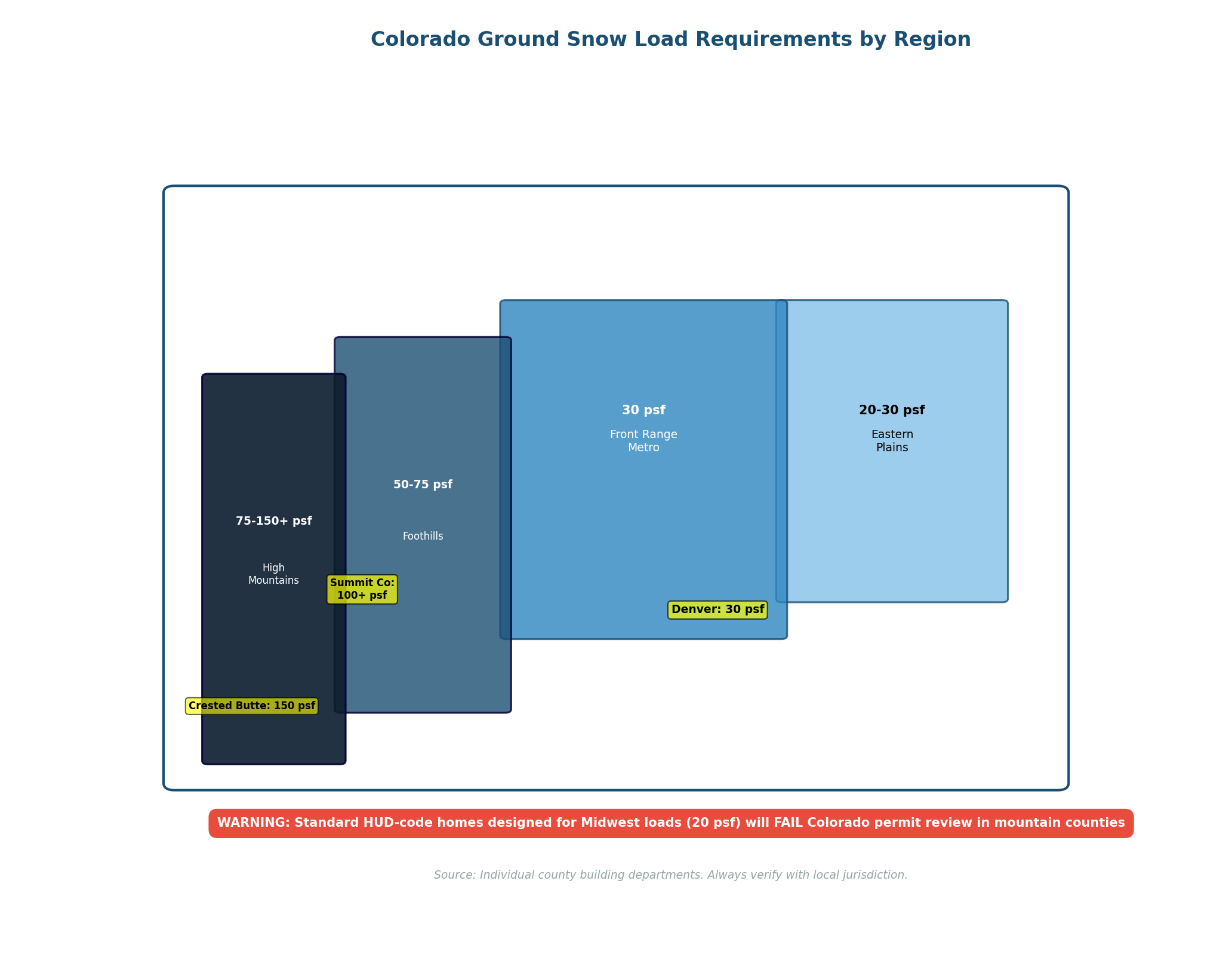
Let's get specific. Denver's ground snow load: 30 pounds per square foot.
Now drive west. Forty minutes to the mountains. Clear Creek County, elevation 11,000 feet: 150 psf. That's a 5x difference. Not a typo. Five times the structural demand on your roof.
Here's why this matters. Your roof doesn't just hold a few flakes. Snow accumulates. Melts. Refreezes into ice. A 4-foot drift on your roof at 150 psf means your trusses are carrying 600 pounds per linear foot of structure. Standard 24-inch on-center truss spacing (the normal spacing for Midwest construction) will snap under that load.
Modular manufacturers know this. They can customize the roof package before the module leaves the factory. Options include:
Heavy-timber trusses. Thicker, stronger, engineered to handle 100+ psf without deflection. More expensive. Necessary at altitude.
Closer truss spacing. Instead of 24 inches on-center, move to 16 inches. That spreads the load across more members. It costs more material. It also keeps your roof intact.
Collar ties and wind bracing. Additional framing members that prevent lateral movement and increase overall truss rigidity.
But here's the critical step you must take: before any engineering happens, pull your county's design criteria document. This is public. Clear Creek County publishes theirs at https://www.clearcreekcounty.us/355/Design-Criteria-Construction-Document-Re. Alamosa County at https://www.alamosacounty.org/Faq.aspx?TID=22. Gunnison County at https://www.gunnisoncounty.org/425/Climate-Design-Criteria.
Your county document tells you the exact snow load requirement for your elevation and location. It also specifies wind speed, seismic zone, and exposure category. Print it. Email it to your modular manufacturer. Tell them: "Engineer this home to meet these specs before you build."
Most manufacturers won't balk. Snow load customization is routine for anyone who builds in snow country. What they won't do is guess. And you can't ask them to guess.
Once the engineering package comes back from the manufacturer, hire a Colorado structural engineer to review it. Not a builder. Not a general contractor. A PE (professional engineer) licensed in Colorado. They'll stamp the plans and verify compliance with your county's requirements. This costs $800 to $1,500. It's the least expensive insurance you'll buy.
Wind Shear, Exposure C, and the Foundation Connection
Colorado's Front Range is a wind tunnel.
Elevation changes create pressure gradients. Mountain passes funnel air like a jet nozzle. Properties classified "Exposure C" (open terrain with scattered obstructions, no significant windbreaks for a certain distance) experience sustained winds of 40-60 mph and gusts exceeding 100 mph routinely.
Building codes require design wind speeds of 115 mph (three-second gust, Vult) in most Colorado counties. Some Front Range properties: 120 mph or higher.
What does 115 mph wind do structurally? It creates lateral (sideways) force on your walls and roof. A typical single-story modular home 40 feet wide experiences roughly 18,000 pounds of lateral force at 115 mph design speed. That's the sideways push trying to deflect your walls and tear your roof off the structure.
Conventional stick-built homes resist this lateral load using shear panels: sheets of OSB or plywood nailed to the framing to create a rigid diaphragm. It works. But nailing depends on consistent quality and correct installation.
Modular homes have an advantage here. Because modules are built in a factory, transported via truck (bouncing on highways), and lifted onto foundations, the entire structure is glued and screwed together. That means the frame is built to move without racking. The walls are rigid. The roof is rigid. The "box" itself resists lateral loads better than a conventionally-built equivalent.
The weak point? The foundation connection.
If your module is rigidly connected to the foundation and the wind tries to lift the structure, the foundation connection becomes a tension joint. The module wants to move up. The foundation wants to stay put. The hardware connecting them carries enormous tensile (pulling) force. Standard anchor bolts with washers and nuts won't do it. You need engineered hold-down hardware.
Simpson Strong-Tie makes the standard products here. LUS (lateral uplift strap) hardware. Foundation straps rated for specific uplift loads. These are bolted to the module's rim beam (the perimeter beam running around the bottom of the structure) and anchored into the foundation with expansion anchors or cast-in-place bolts.
The engineering detail matters hugely. The anchor bolt pattern, spacing, diameter, and the load rating of the hold-down hardware must match the lateral load calculated for your specific county's wind design speed. A Colorado structural engineer calculates this. They provide the detail to the contractor. The contractor installs it to spec. Period.
Modular manufacturers can provide the rim-board connection detail (where the module sits on the foundation), but the foundation design itself falls to the site engineer. Don't skip this step. Foundation failure in wind doesn't result in cosmetic damage. It results in total structural failure.
The High-Altitude UV Threat — What Actually Survives at 7,000 Feet
Here's something Midwest builders don't think about: altitude changes material lifespan dramatically.
Denver is 5,280 feet. UV radiation there is already roughly 20% more intense than at sea level. Summit County is 9,000-10,000 feet. Teller County (Colorado Springs area) sits at 6,000+ feet. At those elevations, UV intensity increases by 10-12% per additional 1,000 meters. That's not a marketing claim. It's atmospheric physics. Less air above you means less filtering of ultraviolet radiation.
What does this mean for your home's exterior?
Vinyl siding. At sea level, vinyl lasts 20-25 years before fading noticeably and becoming brittle from UV damage. At 8,000 feet? 8-12 years. It cracks. It loses flexibility. It looks weathered. Vinyl windows exhibit the same problem: the frame becomes brittle and develops stress cracks around the mullions (the frame pieces holding multiple panes).
Asphalt shingles. At sea level, manufacturers rate them for 20-25 year lifespans. At altitude, UV degrades the asphalt binder and granule adhesion faster. Expect 12-15 years before major shedding of granules, curling, and leaks. Asphalt shingles are a temporary solution on a Colorado mountain home.
What works?
James Hardie fiber cement siding. Compressed wood fiber and cement, no vinyl. Dimensionally stable across temperature swings. Resistant to UV degradation. Fire-resistant (critical in Colorado wildfire zones). Lifespan: 30+ years in mountain settings. Honestly, if you're building in Colorado above 6,000 feet, this is baseline. Not optional.
Standing-seam metal roofing. Aluminum or steel with a Kynar 500 or Hylar 5000 polyester finish (these coatings resist UV and weathering). Expected lifespan in mountain settings: 40-70 years. The metal itself won't degrade. The fasteners and seals are the variables. But a proper standing-seam installation (with stainless fasteners and compatible sealants) will outlast the house.
Composite decking. Trex, Fiberon, or similar products. These blend wood fiber and plastic polymer, UV-stabilized. Won't rot, splinter, or crack from freeze-thaw cycles. More expensive than pressure-treated lumber. Worth it on a mountain home where you're exposed to 350+ days of intense sunlight per year.
Low-E insulated windows. Double-pane (at minimum) with low-E coatings on the interior surfaces. The coating is a microscopically thin layer of metallic oxide that reflects infrared radiation (heat) while transmitting visible light. It also blocks significant UV radiation. Look for windows with UV transmission ratings under 3% (standard high-altitude window spec in Colorado).
These aren't luxury upgrades. They're baseline engineering decisions for a home in Colorado mountains. Budget accordingly.
Getting Your Modular Home Colorado-Certified
The legal pathway for modular homes in Colorado has specific steps. Skip any of them and you'll face permitting delays or outright rejection.
Step one: Identify your county's design criteria. Your modular manufacturer needs the exact ground snow load, design wind speed, seismic zone, and building occupancy classification for your location. Don't guess. Pull the document from your county website. Print it. Send it.
Step two: Provide these specs to your modular manufacturer before design is finalized. Most will ask for this proactively. Some won't. Make sure they have it. Tell them you'll also have a local engineer review their plans against your county's requirements. They need to know upfront that you're not signing off on generic Midwest engineering.
Step three: Once the manufacturer completes the engineering package (plans, truss calcs, foundation connection details, elevation drawings), hire a Colorado-licensed structural engineer to review it. This PE will compare the manufacturer's calculations against your county's design criteria and your site's specific exposure category. They'll stamp the plans and issue a professional opinion: compliant or non-compliant.
Step four: The Colorado Department of Housing (DOH) issues insignia stickers for modular homes that meet state code and local building standards. Your manufacturer submits the engineered plans to the DOH for review and insignia certification. This is not optional. A modular home without DOH insignia cannot be legally installed in Colorado. The DOH stamp proves the home was factory-built under controlled conditions and engineered to code.
The entire process typically takes 4-6 weeks once plans are submitted. Budget for it. It's the legal requirement, not a bureaucratic hassle.
Return to Breckenridge
The family near Breckenridge rebuilt. This time with a Colorado-specific modular manufacturer. Before the first truss was cut, they pulled the Summit County design criteria: 120 psf ground snow load, 115 mph design wind, Exposure C, 10,000 feet elevation.
The engineering package came back with heavy-timber trusses, 16 inches on-center, collar ties, and wind bracing. James Hardie siding on all elevations. Standing-seam metal roof with Kynar finish. Low-E insulated windows. Foundation connection engineered for 120 mph wind with Simpson Strong-Tie hold-downs rated for the calculated uplift load.
The DOH issued insignia. The local structural engineer stamped the plans. Permits were approved.
Second winter: 18 inches of overnight snow. Wind gusts hit 60 mph. The roof didn't flex. The siding didn't fade. The foundation connection held. Zero damage.
That's what Colorado engineering looks like.
Your modular home can be that reliable. But it requires engineering specific to your location, material choices appropriate to altitude and UV exposure, and foundation detailing that resists Colorado wind. Don't buy generic. Don't trust a manufacturer who designed for Ohio. Pull your county's design criteria. Engage a Colorado engineer. Build it right.
Olerra builds modular homes and ADUs engineered specifically for Colorado mountain locations. We pull your county's design criteria before we start. We customize the roof package, the siding, the roofing, and the foundation connection to match your site's specific engineering requirements. We handle the DOH certification pathway. And we deliver a home that survives Colorado weather for decades, not years.
For the full picture on modular ADU costs, financing, and Colorado law, read our guide: The Ultimate Guide to Buying a Modular Home and ADU in Colorado.
Frequently Asked Questions
What snow load do I need for a modular home in Colorado?
It depends on location. Denver metro requires ~30 psf; foothills areas need 50–75 psf; mountain counties like Summit and Clear Creek can require 100–150+ psf. Always verify with your local building department.
Why do out-of-state modular homes fail Colorado inspections?
Most national manufacturers design to Midwestern snow loads (20–25 psf). Colorado’s mountain counties require 3–8x that capacity—these homes fail structural plan review and cannot receive a building permit.
What exterior materials should I use for a Colorado modular home?
Fiber cement siding (James Hardie), standing-seam metal roofing, and composite decking are the correct choices for Colorado’s elevated UV exposure, temperature swings, and moisture cycles.